
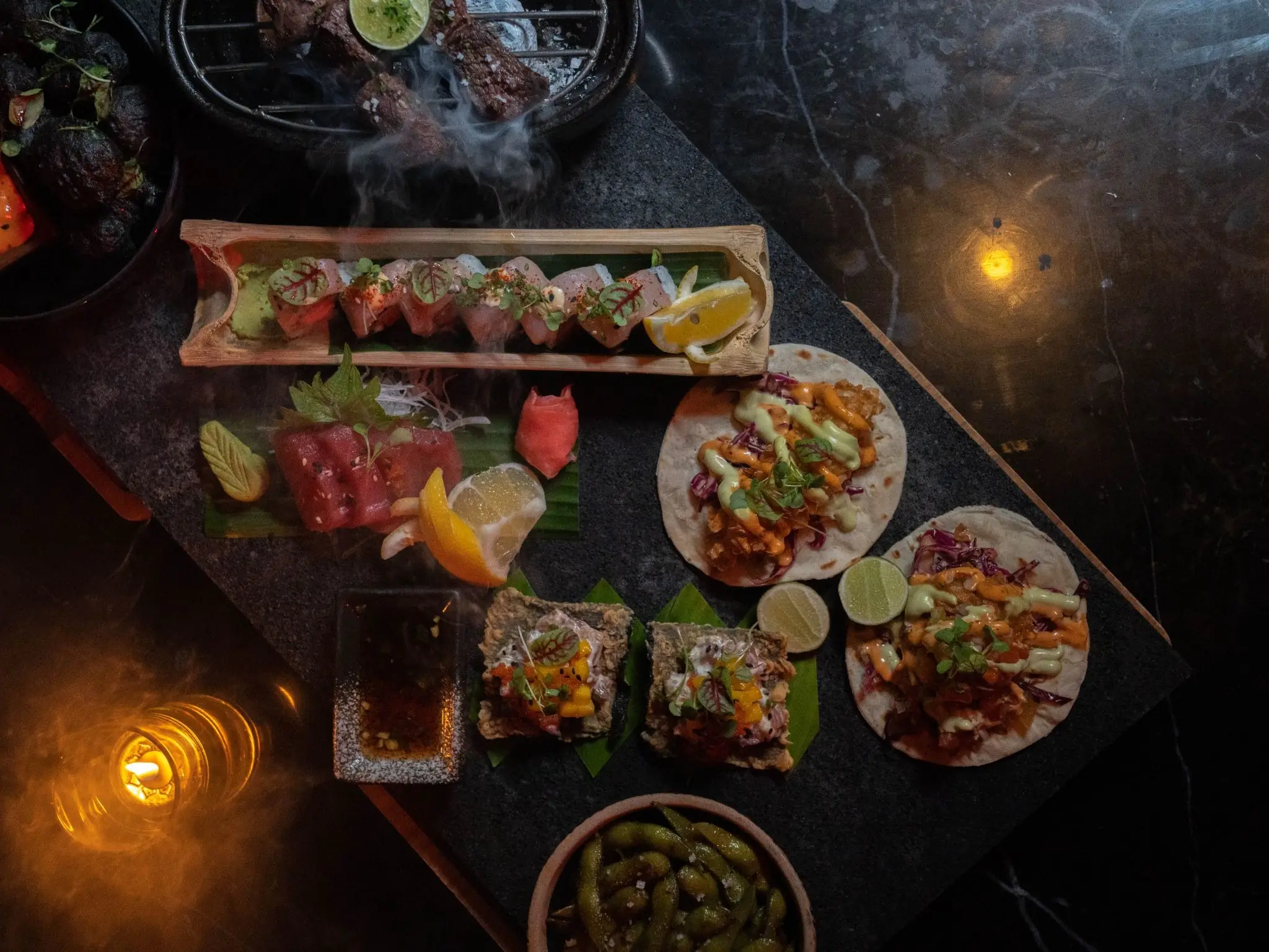
Japanese Mexican Fusion Bali: Inside Tabu Bali’s Menu
Japanese and Mexican cuisine share more common ground than their geography suggests. Both cultures are obsessed with umami. Both have a deep tradition of acid yuzu and citrus in Japan, lime and vinegar in Mexico. Both celebrate raw seafood, fire, and the precise application of salt. When these two culinary traditions are brought together by a kitchen that understands the logic of both, the results are not novelty they are inevitability. At Tabu Bali in Uluwatu, the Japanese-Mexican fusion menu is not a marketing concept. It is the product of genuine culinary reasoning applied nightly in one of Bali’s most dramatic settings.
| “The question the kitchen asks every time a dish is developed is not ‘how do we combine Japanese and Mexican?’ It is ‘which tradition solves this problem best?’ Sometimes the answer is one. Sometimes it is both. That is the menu.” The guiding principle behind Tabu Bali’s kitchen |
Why Japanese and Mexican Cuisine Work Together
The case for Japanese-Mexican fusion bali as a coherent culinary category starts with flavour logic, not geography. The two cuisines share structural similarities that make them genuinely compatible at the ingredient and technique level not just the concept level.
Japanese cooking is built on umami the deep savoury quality produced by fermented soy, miso, dashi, and aged proteins. Mexican cooking finds its equivalent through the Maillard reaction on the grill, the depth of dried chillies, and the complexity of mole. Both are looking for the same quality in the finished dish: resonance. Flavours that linger and build rather than peak and fade.
The acid structures are similarly aligned. Yuzu, rice vinegar, and ponzu in Japanese cuisine perform the same structural function as lime, citrus, and vinegars in Mexican cooking. They lift the dish, cut through fat, and reset the palate. Both cuisines understand that acid is not a flavouring it is a tool for balance.
Raw fish is central to both traditions. Japanese sushi and sashimi culture and Mexican aguachile and ceviche culture both apply citrus and salt to raw seafood in ways that are technically different but philosophically identical. This overlap is where the Tabu Bali kitchen finds some of its most natural fusion expressions.
| JAPANESE CULINARY DNA | MEXICAN / LATIN CULINARY DNA |
| Precision & restraint | Boldness & abundance |
| Umami depth (soy, miso, dashi) | Smoke & char (chilli, mezcal, grill) |
| Clean acidity (yuzu, rice vinegar) | Bright acidity (lime, citrus, vinegar) |
| Raw & barely-cooked techniques | Fire & heat techniques |
| Texture as a primary consideration | Contrast of textures crispy, creamy, tender |
| Minimalist presentation | Vivid colour, abundant garnish |
| Sake, Japanese whisky | Tequila, mezcal, agave spirits |
Fusion Done Right: How Tabu Bali Approaches the Menu
The history of fusion cuisine is not all success. For every kitchen that has found genuine insight in the combination of two culinary traditions, there are ten that have produced confusion. The difference is almost always the same: whether the combination serves the food or serves the concept.
Tabu Bali’s Japanese-Mexican fusion approach is built on a set of principles that put the dish first. The result is a menu that reads as a unified whole rather than two separate identities competing for attention.
| FUSION DONE WRONG | TABU BALI APPROACH |
| Combining two cuisines for novelty | Combining two cuisines because the flavour logic demands it |
| Japanese aesthetics with Mexican ingredients bolted on | Each dish built from a single culinary question: which tradition solves this best? |
| Confusion masquerading as creativity | Clarity every component earns its place |
| Two separate menus stitched together | One unified menu with a coherent flavour identity |
| ‘Fusion’ as a marketing term | Fusion as the actual methodology of the kitchen |
The most important line in that comparison is the last one. At Tabu Bali, Japanese-Mexican fusion is not a description used for marketing. It is the actual working method of the kitchen. Every dish on the menu begins with a question about which tradition provides the best answer, and ends with a plate that reflects the honesty of that answer.
Inside the Tabu Bali Menu: Structure and Signature Dishes
The Tabu Bali menu is designed for sharing an approach that suits both the Japanese izakaya tradition and the Mexican way of eating, where the table is populated with multiple dishes rather than individual portions. It is also the right format for a supper club, where the meal is meant to unfold slowly across the full evening rather than arrive and conclude in ninety minutes.
| COURSE / CATEGORY | STYLE | WHAT TO EXPECT |
| Appetisers & Raw Bar | Japanese technique, Latin seasoning | Ceviche with yuzu and togarashi. Tiradito with miso-citrus dressing. The raw bar sets the tone. |
| Sushi & Maki | Classic Japanese form, Latin-influenced fills | Sushi rolls with smoked meats, pickled jalapeño, and chipotle aioli alongside traditional builds. |
| Tacos & Small Plates | Corn tortilla base, Japanese-inspired proteins | Tacos with yuzu-marinated fish, wasabi guacamole, and nori-seasoned toppings. |
| Robata & Grill Plates | Japanese robata technique, Latin marinades | Yakitori-style skewers with mezcal glazes and chilli-lime finishes the grill is where the fusion is most visible. |
| Sharing Large Plates | Both traditions applied at scale | Built for groups dishes designed to anchor the table and sustain the full dinner service. |
| Dessert | Japanese minimalism with tropical fruit | Clean, light finishes palate-resetting rather than heavy. Right for an evening that continues into nightlife. |
The Fusion in Action: Three Dish Stories
Understanding how the Japanese-Mexican fusion concept works in practice is best done through specific dishes. These three examples show the kitchen’s reasoning across different sections of the menu.
| The Fusion CevicheJapanese element: Yuzu, ponzu, sesame oil the citrus acid base and the umami seasoningLatin element: Leche de tigre technique, aji amarillo, corn cancha for textureThe result: A ceviche that tastes simultaneously of the Pacific coast of Japan and the cevicherias of Lima but is fully itself | Yakitori TacoJapanese element: Binchotan-grilled chicken thigh, tare glaze, precision of the grillLatin element: Corn tortilla, pickled onion, chipotle crema, fresh herbThe result: The moment you understand why the kitchen does not choose between the two traditions it needs both to make this work | Sushi TostadaJapanese element: Sushi-grade fish, soy-cured, precise cuts, noriLatin element: Tostada base, avocado purée, jalapeño, citrusThe result: What happens when Japanese raw fish culture meets Mexican antojitos crunch and clean fish and heat, in the right proportions |
The Menu in the Context of the Full Evening
Understanding the Tabu Bali menu requires understanding the context it is served in. This is not a restaurant where the food is the entire product. The menu is the first movement of an evening that builds through cocktails, transitions, and live DJ nightlife into something larger than any individual dish.
The sharing format serves this context well. Dishes arrive continuously across the dinner service rather than in set courses which means the table stays active, the conversation flows, and the pace of the evening is set by the group rather than by a fixed service structure. By the time the kitchen winds down and the DJ programming builds, the table has been properly fed and the energy is right.
The dessert philosophy matters here: Tabu Bali’s dessert section is deliberately light clean, citrus-forward, palate-resetting. This is not a kitchen that finishes with heavy cream and chocolate in a venue where dancing is coming. The meal is calibrated for the arc of the evening, not just for itself.
| TABU BALI MENU POSITIONING IN BALI’S DINING SCENEBali has excellent Japanese restaurants (primarily traditional) and occasional Mexican or Latin options (primarily casual). No other venue on the island applies genuine culinary reasoning to the combination of both at fine dining quality. Tabu Bali’s Japanese-Mexican fusion menu is, in the truest sense, unique in Bali not because no one has attempted the concept, but because no one else has built a kitchen capable of executing it at this level. |
How to Order at Tabu Bali: Getting the Most From the Fusion Menu
- Order to share across the full table. The menu is built for this. Individual ordering misses the point the idea is that the table experiences multiple dishes across both Japanese and Latin traditions in the same meal.
- Start with the raw bar and lighter starters. The ceviche and raw preparations open the palate let the heavier, grilled dishes arrive mid-meal rather than first.
- Order across both halves of the fusion. Resist the instinct to order only the dishes that sound familiar. The most interesting plates are the ones where the kitchen’s reasoning is most visible the yakitori taco, the fusion sushi, the Japanese-seasoned grilled dishes.
- Pair with the cocktail programme. The Tabu Bali bar is designed to complement the kitchen. The sommelier equivalent at this venue is the bar team ask for cocktail pairings with your order.
- Leave time for the grill section. The robata and grill plates take longer to prepare and are the most complex expressions of the Japanese-Mexican fusion concept. Order them when you arrive and let them come when they are ready.
- Do not rush. The menu is designed for a full evening’s dining not a two-course dinner in sixty minutes. This is supper club food: meant to unfold, build, and sustain the table from 7 PM through to when the DJ takes over.
| Book Your Table at Tabu Balitabubali.com/book · WhatsApp for reservations, VIP tables & group bookings |
| Explore the full dining experience: Discover the complete menu at Tabu Bali → |
| The cocktail programme that pairs with the kitchen: Explore the Tabu Bali drinks menu → |
| Plan your full evening: Reserve your table at Tabu Bali → |
Frequently Asked Questions
What is Japanese-Mexican fusion cuisine?
Japanese-Mexican fusion cuisine combines the culinary techniques, ingredients, and flavour philosophies of Japanese and Mexican cooking. The approach works because both traditions share structural similarities: umami depth, acid-forward seasoning, raw seafood preparation, and fire-based cooking techniques. When applied by a kitchen that understands both traditions, the result is a coherent and distinctive cuisine rather than a simple blending of two menus.
Where can I find Japanese-Mexican fusion food in Bali?
Tabu Bali in Uluwatu is the primary destination for Japanese-Mexican fusion food in Bali. The restaurant applies genuine culinary reasoning to the combination not simply adding Japanese ingredients to Mexican dishes or vice versa, but building each dish from first principles using whichever tradition provides the best answer. No other venue in Bali currently offers this combination at comparable quality.
What dishes does Tabu Bali serve?
The Tabu Bali menu includes raw bar preparations (ceviche and tiradito with Japanese seasoning), sushi and maki with Latin-influenced fills, fusion tacos with Japanese-marinated proteins, robata-grilled sharing plates with mezcal and chilli glazes, and large sharing plates designed for groups. The menu is built for sharing across the table and is calibrated to sustain a full supper club evening from dinner through to nightlife.
Is Japanese and Mexican food fusion a real cuisine?
Yes and it has genuine culinary precedent. The Nikkei cuisine tradition (Japanese-Peruvian fusion) has been established in South America for over a century, with restaurants like Nobu and Central Restaurante helping bring it to global attention. Tabu Bali’s Japanese-Mexican fusion is a distinct expression of the same underlying logic: Japanese culinary precision applied to Latin American ingredients and flavour profiles. The combination is not arbitrary it is grounded in real flavour compatibility.
What does the Tabu Bali menu cost?
Tabu Bali is priced as a premium dining experience reflecting the quality of ingredients, the culinary skill involved, and the full evening experience including cocktails, live DJ, and supper club format. For current pricing and menu details, visit tabubali.com/dine or contact the team directly via WhatsApp. For visitors familiar with fine dining pricing in major cities, the value at Tabu Bali is consistently considered excellent.
Can I eat at Tabu Bali if I do not like spicy food?
Yes. The Japanese-Mexican fusion menu at Tabu Bali uses chilli and spice with precision rather than volume. Heat is a component of some dishes but is not applied indiscriminately. The raw bar and sushi sections of the menu in particular draw heavily from the Japanese side of the fusion, where restraint is central. The bar team and kitchen can also advise on lower-heat options at the time of ordering.